Cao Dai Holy See in Tay Ninh: A Vietnam Culture Day 2026 Centennial Visitor's Guide
A practical 2026 guide to the Cao Dai Holy See in Tay Ninh during its centennial year. Covers ceremony times, dress codes, transport from Ho Chi Minh City, costs, and etiquette for attending the noon prayer. Useful for visitors planning a half-day or full-day trip that may include Cu Chi Tunnels or Ba Den Mountain.

Related reading
Keep exploring Vietnam
- 1
- 2
- 3
At a glance
- Best time
- 2026 centennial year; daily noon ceremony is most visitor-friendly
- How long
- Half-day from Ho Chi Minh City: 2.5 hours each way plus 1-2 hours at temple
- Budget
- Entry by donation; transport is main cost (bus or private car)
- Getting there
- 90 km from Ho Chi Minh City; bus from Ben Xe Mien Tay or private car
- Language
- Vietnamese; some English-speaking guides available
- Currency
- Vietnamese dong (VND)
Why the Vietnam Culture Day 2026 Centennial Matters
Caodaism was founded in Tây Ninh in 1926 by Ngô Văn Chiêu, making 2026 the religion's 100th anniversary. For travelers building a Vietnam Culture Day 2026 itinerary, the centennial turns the Cao Dai Holy See into more than a day trip: it's a chance to witness a faith at a once-a-century moment, 90 km northwest of Ho Chi Minh City.
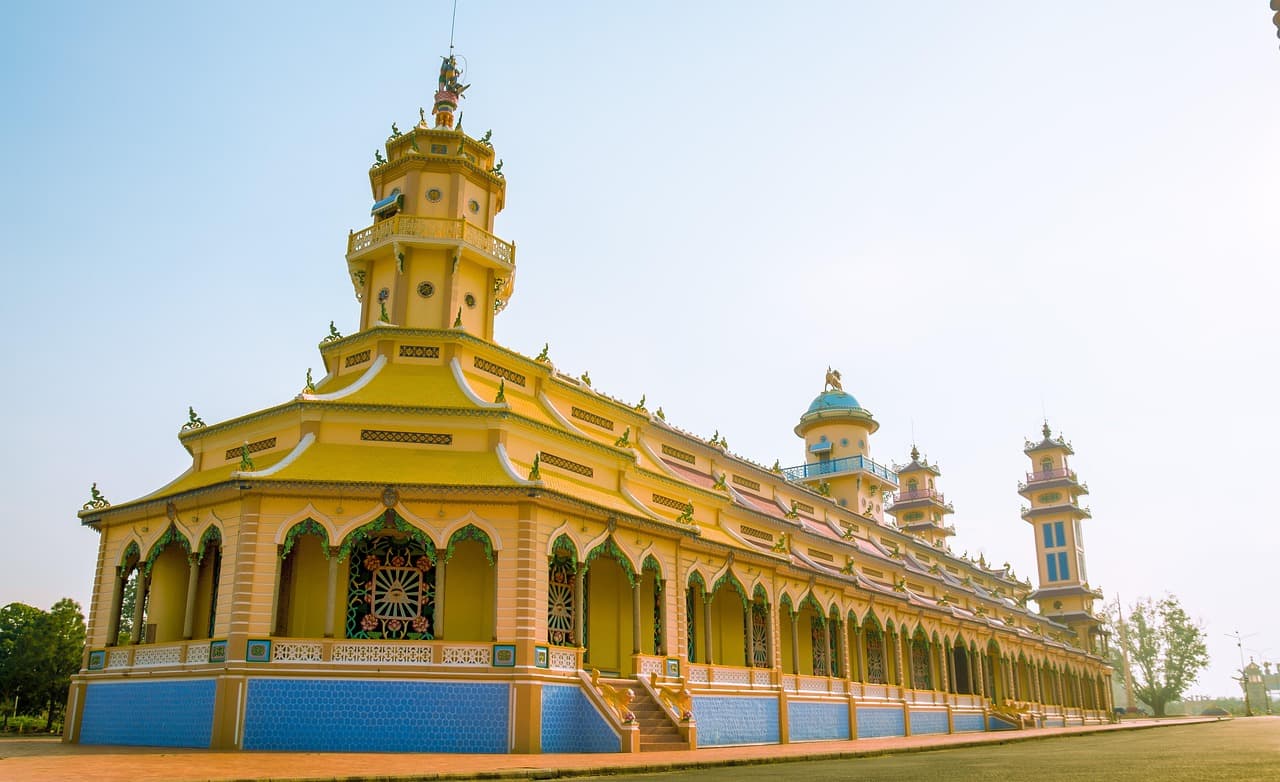
The Holy See (Toà Thánh Tây Ninh), built between 1933 and 1955, is the spiritual center. Its architecture mixes neo-Gothic columns with Chinese-influenced roofs, and the Divine Eye—a left eye surrounded by rays—appears above the altar and on the facade. Visitors watch noon prayers from an upper balcony; the 12:00 service is the most visitor-friendly, with entry by donation rather than a fixed ticket.
Caodaism's syncretism draws explicitly on Confucianism, Taoism, Buddhism, and Christianity. The faith's saints include Victor Hugo and Joan of Arc alongside Buddha and Jesus, which can surprise first-time visitors. Ngô Văn Chiêu formalized this blend in 1926, and the 2026 centennial may bring additional ceremonies beyond the usual four daily prayer times. Confirm any special events with Tay Ninh provincial tourism before setting out.
Getting There for a Vietnam Culture Day 2026 Visit
Getting There for a Vietnam Culture Day 2026 Visit
The Cao Dai Holy See lies about 90 km northwest of Ho Chi Minh City, and planning a Vietnam Culture Day 2026 visit means budgeting roughly 2.5 hours each way by car or bus. Traffic on National Route 22 can add 30–45 minutes on weekday mornings or before public holidays, so aim to leave District 1 by 7:00 if you want to catch the noon ceremony.
Buses leave from Ben Xe Mien Tay (Western Bus Station) in Ho Chi Minh City throughout the morning. Buy a ticket for Tay Ninh town (around 80,000–100,000 VND) and tell the conductor you want the Cao Dai Holy See; most drivers stop at the Long Hoa market intersection, a 5-minute walk from the temple gate. The bus leg takes closer to 3 hours with stops, so a private car or taxi is worth considering if you have only one day.
The Holy See is commonly paired with the Cu Chi Tunnels, which sit roughly halfway along the route, or with Ba Den Mountain near Tay Ninh town. A hired car with driver typically costs $50–70 round trip including waiting time, but confirm current prices locally—2026 centennial events can push up demand on weekends.

Ceremony Times: Planning Your Vietnam Culture Day 2026 Visit
At the Cao Dai Holy See in Tây Ninh, prayer services run four times daily—6:00, 12:00, 18:00, and 24:00—and the noon service is the easiest for most visitors to attend. The 90 km drive from Ho Chi Minh City takes about 2.5 hours, so a morning departure lets you arrive by 11:30, climb to the upstairs visitor balcony, and watch the full ceremony without an overnight stay. Entry is by donation, not a fixed ticket, but dress modestly (shoulders and knees covered) and remove your hat before entering.
During the noon service, which lasts roughly 45 minutes, you must stay in the balcony area and keep movement to a minimum. Speak softly, or not at all, once prayers begin. Photography is allowed outside and from the balcony before and after the service, but cameras are not permitted during the actual chanting and rituals. If you miss noon, the 6:00 service is quieter but requires an early start, while the 18:00 service works well if you combine the visit with nearby Cu Chi Tunnels. The midnight service is atmospheric but best left to overnight guests.
If you're planning your Vietnam Culture Day 2026 visit on November 24, note that the centennial year may bring special ceremonies or larger crowds. Confirm the schedule with the Tây Ninh tourism office a few days ahead, and arrive at least 30 minutes early to secure a good balcony position.
Dress Code and Etiquette
Entry to the Cao Dai Holy See is by donation—there is no fixed fee—but the dress code is non-negotiable. Shoulders and knees must be covered before you pass the gate. Lightweight long pants or a long skirt work well in Tay Ninh’s heat; carry a scarf or shawl to drape over bare shoulders if you arrive in a sleeveless top. Remove your hat before entering the main hall, and leave bulky bags at the entrance if possible. Black clothing is best avoided as a sign of respect, though it is not prohibited.
Inside, stay in the designated visitor balcony along the upper gallery. The main floor is reserved for Cao Dai clergy and worshippers. Keep your voice low; even whispered conversations can carry during the noon service, which begins at 12:00 and is the most visitor-friendly ceremony. Photography is allowed outside but stops once prayer starts; lower your camera and do not use flash.
Women may enter the main hall but should not approach the altar or step onto the central floor. If you need to sit, use the balcony benches. During the 2026 centennial year, special ceremonies may draw larger crowds, so arrive 20–30 minutes early to find balcony space and observe the dress check before the 12:00 service.
What You'll See: Architecture and Symbolism
Construction began in 1933 and finished in 1955, a 22-year span that produced a facade mixing neo-Gothic bell towers, curved Baroque balconies, and Chinese roof ridges all painted pastel yellow with pink trim. The Divine Eye, set inside a triangle with radiating rays, sits above the main entrance and repeats on windows and interior details.
Inside the prayer hall, pink columns are wrapped with carved green and gold dragons, and the ceiling is hand-painted with sky, clouds, and stars. At the far end, the altar area is off-limits to visitors—only clergy and selected worshipers may approach—but the upper balcony near the entrance gives a clear view of the ornate altar and its towering Divine Eye during the noon ceremony.
In the 2026 centennial year, expect additional banners and floral displays around the hall, but the core architectural features remain exactly as they were when the Holy See was completed in 1955.
Combining Cao Dai with Nearby Sights
Planning a Vietnam culture day 2026 loop from Ho Chi Minh City with Cu Chi Tunnels and the Cao Dai Holy See means leaving by 7:00 a.m. and hitting Cu Chi first. The Ben Dinh site (~60 km) works best; a guided walk through the narrow passages takes 60–90 minutes. Then drive 60–70 km further to Tay Ninh, arriving at the Holy See by 11:30 a.m. for the noon ceremony.
The noon service is the easiest of the four daily ceremonies (6:00, 12:00, 18:00, 24:00). Entry is by donation—20,000–50,000 VND common—and shoulders and knees covered. Allow 1–2 hours: ceremony lasts about 45 minutes, plus time to photograph the Divine Eye facade outside. In 2026, centennial events may add processions; confirm locally. Photography allowed outside, restricted during prayer.
If daylight remains, Ba Den Mountain adds a cable car to a summit with a 72-meter Buddha statue. The drive from the Holy See takes 30–40 minutes, and the last cable car runs around 5:30 p.m., so you can catch sunset before the 2.5-hour drive back to HCMC, arriving ~9:00 p.m. If that feels too rushed, skip Ba Den and keep the Cu Chi–Cao Dai pairing.
Practical Tips for Vietnam Culture Day 2026 Visitors
Practical Tips for Vietnam Culture Day 2026 Visitors
Entry to the Cao Dai Holy See in Tay Ninh is by donation only—there is no fixed ticket price, though most visitors leave 20,000–50,000 VND (about $0.80–$2) in the offering box near the main entrance. For Vietnam Culture Day 2026, when the syncretic faith celebrates its centennial, the daily noon ceremony at 12:00 remains the most visitor-friendly, but the anniversary may add special rites or larger crowds. English-speaking guides are available at the temple gate for around 150,000–300,000 VND per group, and a small tip of 20,000–50,000 VND is expected if they lead you through the prayer balcony.
Because 2026 is the religion's 100th year, local tourism offices in Tay Ninh advise confirming any additional centennial events—some may be announced only one or two weeks ahead. Ceremony times can also shift during Tết (Vietnamese Lunar New Year, usually late January or February); the 6:00, 12:00, 18:00, and 24:00 schedule is not guaranteed during festival days, so check the official Tay Ninh Department of Culture, Sports and Tourism channels or call the Holy See office. Drone use over the temple complex is not clearly documented in official visitor rules. If you plan to fly a drone for Vietnam Culture Day 2026 coverage, ask local police or temple security before launching; unauthorized drones may be confiscated.
Frequently asked questions
No fixed fee. Entry is by donation. If you use an English-speaking guide, a small tip is expected.
Dress modestly with shoulders and knees covered. Remove hats before entering. Avoid black clothing if possible, though it is not prohibited.
Photography is allowed outside, but during prayer it is restricted. Use the visitor balcony, avoid flash, and do not photograph worshipers without permission.
By bus from Ben Xe Mien Tay or by private car/taxi. The distance is about 90 km and travel time is about 2.5 hours. Many visitors combine the trip with Cu Chi Tunnels.
Travel details change — opening hours, prices, and schedules can vary by season. Please verify current information on official websites before your visit.
Sources
- vietnamcoracle.com — Primary source
- travelfish.org — From research brief
- theculturetrip.com — From research brief
- lonelyplanet.com — From research brief
- vietnam.travel — From research brief
Loading reviews…
About the author
Trần Thị Diệu Hằng
Culture & Coast Editor
Diệu Hằng edits Vietpeep's culture, heritage, and coastal coverage with a preference for clear, unhurried prose. She looks for the details that give a place its pace — temple bells, fish-drying racks, the quiet of an island morning — and cuts adjectives until they surface.
All articles by Thị Diệu HằngRelated posts

Vietnam Culture Day 2026 at Ho Chi Minh City Museum of Fine Arts: a guide's Q&A on tickets, etiquette and the galleries worth your time
Vietnam Culture Day 2026 falls on Monday 23 November, and the Ho Chi Minh City Museum of Fine Arts is the District 1 address to plan around. This Q&A with senior guide Nguyen Thi Lan covers opening hours, ticket prices, the Cham and Khmer rooms, dress and photography rules, and what to confirm before you go.

Vietnam Culture Day 2026 in Cho Lon: FAQ for Thien Hau, Quan Am and Binh Tay Market
This FAQ answers practical questions about spending Vietnam Culture Day on Nov 24, 2026 in Cho Lon, Ho Chi Minh City's Chinese-Vietnamese quarter. It covers dates, transport from District 1, temple etiquette at Thien Hau and Quan Am, Binh Tay Market, donations, dress codes, food, and how to verify the event schedule.

Mekong Delta Khmer pagodas: a Vietnam culture day guide to etiquette and entry fees in 2026
Mekong Delta Khmer pagodas in Tra Vinh, Soc Trang, Can Tho, and Bac Lieu are living Theravada Buddhist complexes, not museums. Entry is usually free, parking costs 5,000 to 20,000 VND, and dress, photography, and greeting rules matter. This Vietnam culture day guide covers do's, don'ts, festival dates, and regional differences for 2026.