Ha Giang Loop Vietnamese Food Guide: 3-Day Route, VND Prices, and Vegetarian Orders
This guide covers what to eat on a 3-day Ha Giang Loop motorbike route for international visitors, from Ha Giang City to Du Gia, with 2026 VND and USD prices, exact market stops, hygiene advice, and phrases for vegetarian and vegan Vietnamese food orders.

Trip plan
Day-by-day itinerary
Day 1
Ha Giang City to Dong Van via Quan Ba and Yen Minh
Eat breakfast pho or banh cuon in Ha Giang City (30,000 to 50,000 VND). Ride to Quan Ba; if it is Sunday, stop at Quan Ba market for rice rolls and corn wine. Continue through Yen Minh for a cooked-to-order lunch, then reach Dong Van for dinner. Sleep in Dong Van and try thang co (50,000 to 100,000 VND) in the Old Quarter.
Related reading
Keep exploring Vietnam
- 1
- 2
- 3
At a glance
- Best time
- September to November and March to May; avoid Tet on 17 February 2026
- How long
- 3 to 4 days for the loop; this guide uses a 3-day food plan
- Budget
- Dishes 10,000 to 120,000 VND; beer 15,000 to 25,000 VND; water 10,000 to 20,000 VND
- Getting there
- Start in Ha Giang City; route goes Ha Giang City, Quan Ba, Yen Minh, Dong Van, Meo Vac, Du Gia
- Language
- Vietnamese; learn 'ăn chay' and 'không thịt, không cá, không mắm'
- Currency
- Vietnamese dong (VND); USD equivalents given for some dishes
When and where to eat on the Ha Giang Loop
Sunday sets the eating schedule on the Ha Giang Loop. Quan Ba, Dong Van, and Meo Vac each hold their weekly market on Sunday, and those are the mornings when highland cooks set out men men, five-color sticky rice, and thang co at the same stalls that sit thin midweek. Market days move with the lunar calendar, so check the schedule locally before you build a route around one.
The standard ride takes 3 to 4 days: Ha Giang City, Quan Ba, Yen Minh, Dong Van, Meo Vac, Du Gia. Ha Giang City's night market runs every evening for pho and grilled skewers, the most reliable Vietnamese food in town after dark. Dong Van Old Quarter has morning stalls for banh cuon and thang den. In Meo Vac, the market is the stop for men men and sticky rice. In Du Gia, homestays cook family dinners, which is often the simplest way to get Vietnamese food made to order.
Dry-season weather runs September to November and March to May, when the roads hold up and market crowds are fullest. Avoid Tet on 17 February 2026: many stalls close and families travel. Outside those windows you can still eat well, but rain slows the northern passes and some vendors pack up early.
Budget for prices 10 to 20% higher in remote districts than in Ha Giang City. Ask your loop operator whether meals and bottled water are included before you assume the quoted price covers them, since inclusions vary by company. Carry small VND notes for market stalls. Remote ATMs are limited and often empty, and few stalls take cards.
Ha Giang City: Vietnamese food at the night market
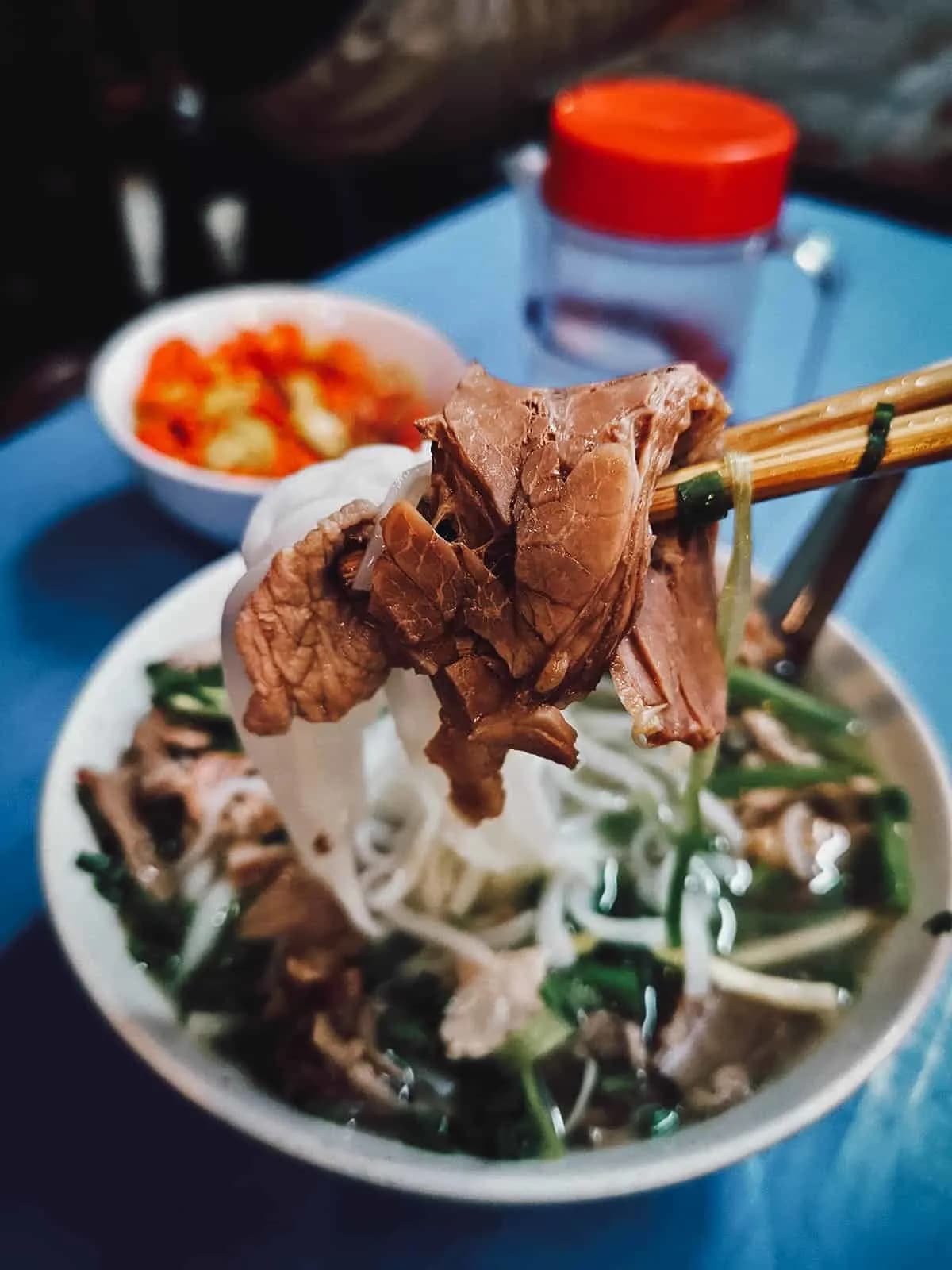
Ha Giang City's night market is the first stop for Vietnamese food on the loop. A bowl of pho or a plate of banh cuon costs 30,000 to 50,000 VND ($1.20 to $2.00). Stalls also sell grilled skewers and other dishes. You eat here before the 3 to 4 day ride through Quan Ba, Yen Minh, Dong Van, Meo Vac, and Du Gia. The market is in Ha Giang City.
Beer costs 15,000 to 25,000 VND. Bottled water costs 10,000 to 20,000 VND. Buy a few bottles for the next day. Before you pay for breakfast at the market, ask if your homestay or hostel includes it. Many do, and that saves you 30,000 to 50,000 VND. The night market runs in the evening, so you can eat dinner and then prepare for the ride.
Eat at busy stalls with high turnover and cooked-to-order food. That's the main hygiene rule. If a stall is empty, keep walking. Order dishes that are cooked after you ask, not ones sitting in trays. Skip pre-cut fruit and ice unless it's machine-made. Carry hand sanitizer because highland clinics are basic. These habits matter more in remote districts where options are fewer.
Prices in remote districts run 10 to 20% higher than in Ha Giang City. The night market is cheaper than remote districts. You'll also find pho and banh cuon at breakfast, but check your homestay first. The night market is a practical start: you eat well, you pay less, and you can ask other riders about road conditions. After dinner, check your bike and gear. The market closes late, but an early start makes the first riding day easier.
Quan Ba, Yen Minh, and Meo Vac: Vietnamese food at Sunday markets
Quan Ba and Meo Vac hold Sunday markets on this stretch; Yen Minh is the lunch stop between them. Quan Ba Sunday market is the first of the three main weekend markets on the loop, and most riders reach it on day one from Ha Giang City. The Vietnamese food here is market fare: rice rolls and corn wine. Market days shift with the lunar calendar, so verify the schedule locally before you plan the ride around it. If the date moves, morning stalls in town still serve pho and banh cuon for 30,000 to 50,000 VND ($1.20 to $2.00).
Yen Minh is the lunch stop between Quan Ba and Dong Van on the standard 3 to 4 day route. Order cooked-to-order dishes rather than food that has been sitting out: com rang rau (vegetable fried rice), dau hu (tofu), and rau xao (stir-fried greens) are reliable picks. Ask about the broth before you order noodle soup, because some pots are built on meat stock.
Meo Vac market sells men men (steamed corn) for 20,000 to 40,000 VND and five-color sticky rice for 20,000 to 35,000 VND. Its Sunday market is one of the three main weekend markets on the route, along with Quan Ba and Dong Van, so plan the ride to land there on a Sunday. Verify the lunar schedule locally, since market days can shift.
Expect to pay 10 to 20% more in Meo Vac and other remote districts than in Ha Giang City. Beer runs 15,000 to 25,000 VND and bottled water 10,000 to 20,000 VND, so a plate of men men and a beer stays under 100,000 VND. In all three towns, eat at busy stalls with high turnover and cooked-to-order food, and carry hand sanitizer, since highland clinics are basic.
Dong Van and Du Gia: Vietnamese food in the old quarter and homestays
Dong Van Old Quarter's morning stalls and Sunday market are the main places to eat Vietnamese food in this part of the loop. The Sunday market is your best bet for banh cuon and thang den. Note that market days shift with the lunar calendar, so verify the schedule locally. Dong Van prices run 10 to 20% higher than in Ha Giang City. Thang co, a horse hotpot, costs 50,000 to 100,000 VND ($2 to $4). Eat at busy stalls with high turnover. Dong Van is a standard overnight stop on the 3 to 4 day loop. Du Gia is the final stop before returning to Ha Giang City.
For smoked buffalo with wild greens, expect to pay 70,000 to 120,000 VND ($2.80 to $4.80). Buckwheat cake is a cheap snack at 10,000 to 20,000 VND. Both sell around Dong Van's market. If you are sensitive to hygiene, skip pre-cut fruit and raw herbs. Bottled water costs 10,000 to 20,000 VND. Beer costs 15,000 to 25,000 VND.
In Du Gia, homestays serve family dinners. Tell your host in advance if you need vegetarian food. Homestays can cook vegetarian dishes if told ahead of time. Use the phrase "ăn chay" and "không thịt, không cá, không mắm" to explain no meat, fish, or fish sauce. Markets in Du Gia have fruit, corn, and sweet potato for self-catering. Confirm no meat broth if you order noodle soup. If you eat meat, family dinners often include smoked buffalo or thang co.
2026 prices vary by 10 to 20% between Ha Giang City and remote districts like Dong Van. Some dishes labeled vegetarian use fish sauce or meat broth, so ask specifically. Check whether your loop operator includes meals and bottled water. Prices from 2024 posts often understate 2026 costs. Verify update dates for all sources. Confirm no fish sauce when ordering.

Hygiene and how to order Vietnamese food safely
The safest meal on the loop is at a stall that is already busy. High turnover means the pho, banh cuon and skewers are cooked to order instead of sitting out, and a queue of local riders is a better signal than any sign. Breakfast pho or banh cuon costs 30,000 to 50,000 VND ($1.20 to $2.00) at these stalls, and the same food at the Ha Giang City night market moves fast enough that nothing waits long.
Water and ice cause most of the trouble. Bottled water costs 10,000 to 20,000 VND and is sold everywhere along the route. Take ice only if it is machine-made, not the cloudy blocks cut from a local supply, and if you are unsure, ask for drinks without ice. Skip pre-cut fruit and raw herbs if your stomach is sensitive, and carry hand sanitizer, since not every stall has running water.
Highland clinics are basic, so pack oral rehydration salts and any personal medicine before you leave Ha Giang City. Ordering vegetarian Vietnamese food takes direct questions. Say 'ăn chay' and 'không thịt, không cá, không mắm' (no meat, no fish, no fish sauce), then confirm the broth, because some vegetable dishes are cooked with meat stock or seasoned with fish sauce. Com rang rau, dau hu and rau xao are the safest orders, but ask whether the sauce contains mắm. Homestay kitchens in Du Gia can cook vegetarian food if you tell them the night before.
Prices run 10 to 20% higher in remote districts than in Ha Giang City. Check what your loop package covers before you budget, including meals and bottled water. Around Tet on 17 February 2026 many stalls close, and market days shift with the lunar calendar, so confirm dates locally.
Vegetarian and vegan Vietnamese food phrases
The key phrases for vegetarian Vietnamese food on the Ha Giang Loop are 'ăn chay' and 'không thịt, không cá, không mắm' (no meat, no fish, no fish sauce). Say both together. In highland Vietnamese food, 'ăn chay' alone may arrive with fish sauce or meat broth, so the second phrase does that work.
Reliable orders include com rang rau (vegetable fried rice), dau hu (tofu), rau xao (stir-fried greens), and noodle soup with vegetable broth. Confirm no meat broth before you order soup. Some dishes labeled vegetarian in markets or small restaurants use fish sauce or meat broth, especially in soups and stir-fries. If the cook nods but looks unsure, repeat 'không mắm' and point at the bottle.
Homestays in Du Gia can cook vegetarian food if you tell them in advance. Markets have fruit, corn, and sweet potato for self-catering. Ask about the broth and fish sauce when you order, and check whether your loop operator includes meals and bottled water.

Frequently asked questions
Eat at busy stalls with high turnover and cooked-to-order food. Skip pre-cut fruit, raw herbs if sensitive, and ice unless machine-made. Bottled water costs 10,000 to 20,000 VND. Carry hand sanitizer, because highland clinics are basic.
It is challenging. Say 'ăn chay' and 'không thịt, không cá, không mắm'. Safe bets include com rang rau, dau hu, rau xao, and noodle soup with vegetable broth. Confirm no meat broth. Homestays can cook vegetarian food if told in advance.
Dishes range from 10,000 VND for buckwheat cake to 120,000 VND for smoked buffalo with wild greens. Beer is 15,000 to 25,000 VND and bottled water 10,000 to 20,000 VND. Prices in remote districts run 10 to 20% higher than Ha Giang City.
September to November and March to May. Avoid Tet on 17 February 2026 when many stalls close. Weekend markets matter most: Quan Ba Sunday, Dong Van Sunday, Meo Vac Sunday. Verify lunar schedule locally.
Travel details change — opening hours, prices, and schedules can vary by season. Please verify current information on official websites before your visit.
Watch: related videos
Ha Giang Loop Vietnamese Food Guide: 3-Day Route, VND Prices, and Vegetarian Orders — Video by MapKoi Travel on Pexels · silent stock clip
Ha Giang Loop Vietnamese Food Guide: 3-Day Route, VND Prices, and Vegetarian Orders — Video by MapKoi Travel on Pexels · silent stock clip
Sources
- vietnamcoracle.com — Primary source
- willflyforfood.net — From research brief
- migrationology.com — From research brief
- reddit.com — From research brief
- tripadvisor.com — From research brief
Loading reviews…
About the author
Nguyễn Phương Anh
Food & Drink Editor
Phương Anh leads Vietpeep's food coverage — street stalls, family kitchens, and regional markets across all three regions of Vietnam. She edits every dish story for what travelers actually need: what it tastes like, what it costs, and which version is worth the detour.
All articles by Phương AnhRelated posts

Ha Giang Loop in 2 Days: A Realistic Route, Licence Rules, and Safety Guide (2026)
This article tests whether the Ha Giang Loop can be done in two days, laying out a realistic route from Ha Giang to Meo Vac and back, licence and permit rules, weather windows, and safety advice for experienced riders and car passengers in 2026.

Ha Giang Loop by Guided Tour: A 5-Day Motorcycle Adventure for International Visitors (2026)
The Ha Giang Loop offers a challenging and scenic motorcycle journey through Vietnam’s far north. This 2026 itinerary focuses on guided tours for international visitors, covering essential logistics, updated prices, entry rules, and practical tips for a safe and immersive experience.

A Practical Guide to Vietnam’s Ha Giang Loop: Riding the Northern Highlands
The Ha Giang Loop is a 300-400 km motorbike route through Vietnam’s remote northern mountains, offering dramatic scenery, ethnic minority culture, and challenging roads. This guide explains route options, permits, rentals, safety, and practical tips for international visitors.