Hang Va and Nuoc Nut cave expedition in Phong Nha: 2-day permits, costs and season
A planning guide to the 2-day Hang Va and Nuoc Nut expedition in Phong Nha-Ke Bang National Park: who holds the core-zone permit, what the trip costs, the 6-8 km of trekking and swimming involved, the February to August season, and the Dong Hoi transfer. Written for travellers who want a technical cave trip that is cheaper than Son Doong and impossible to self-guide.

Trip plan
Day-by-day itinerary
Day 1
Phong Nha village to the first cave and camp
Meet the guide and porters in Phong Nha village for a safety briefing and kit check, then transfer into the national park core zone. Trek through jungle with your group of about 8-10, and enter the first cave section on foot, wading and swimming upstream with a headlamp in cold water. The operator confirms the cave order for your departure at the briefing. Camp overnight with the cook and porters, using the helmets, harnesses and life jackets issued to you.
Related reading
Keep exploring Vietnam
- 1
- 2
- 3
At a glance
- Best time
- February to August; May to July has the clearest water
- How long
- 2 days and 1 night
- Budget
- About 11.5-13.5 million VND (US$450-540) per person, 2026 tariff to confirm
- Getting there
- Fly or train to Dong Hoi, then 45-60 minutes by taxi or shuttle to Phong Nha
- Language
- Vietnamese; expedition guides speak English
- Currency
- Vietnamese dong (VND); carry cash for village expenses
What the Hang Va and Nuoc Nut expedition actually is
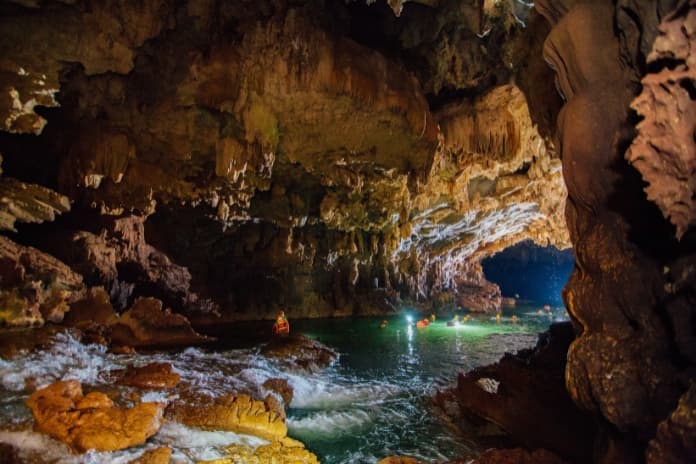
Hang Va and Nuoc Nut are two caves in the core zone of Phong Nha-Ke Bang National Park in Quang Binh province, and you enter them by wading and swimming, not by boat. The park received UNESCO listing in 2003. Hang Va was documented in 2012 by Howard Limbert's British-Vietnamese survey team. Inside Hang Va, cone and calcite formations rise from a shallow lake. Nuoc Nut is entered by wading and swimming upstream along an underground river with headlamps. The water is part of the route from the first cave, whichever cave the operator schedules first.
The standard expedition runs 2 days and 1 night with groups of about 8-10 guests per departure. Trips leave from Phong Nha village, and the operator supplies porters, a camp cook, helmets, harnesses and life jackets. Only a licensed operator holding the park concession may run overnight trips into this zone; Oxalis Adventure currently holds that concession. The national park management board issues the permits, and independent entry is prohibited. If you have seen Phong Nha cave tours advertised as boat rides, this is a different permit category and a different level of access.
This is not the Phong Nha boat trip, and it is not Paradise Cave. There is no self-guided option and no day-trip version into this zone. You need swimming ability, and the route includes 6-8 km of jungle trekking, scrambling and wading in cold water. Flash flooding is the main risk; operators cancel or reroute trips after heavy rain. The operating window is February to August, and the system is normally closed September to January because of flooding. Book 4-8 weeks ahead for March to July departures.
The operator confirms cave order and route at the pre-departure briefing, so plan for either Hang Va first or Nuoc Nut first. Costs and permit terms change, so confirm the 2026 tariff, deposit terms, cancellation and weather-reschedule policy, and minimum age before you book. The expedition has been priced around 11.5-13.5 million VND (roughly US$450-540) per person.
Permits: who can run an overnight trip in Phong Nha's core zone
Oxalis Adventure currently holds the park concession for overnight trips into the core zone of Phong Nha-Ke Bang National Park, and the national park management board issues the permits that make those trips legal. The national park management board prohibits independent entry, so the Hang Va and Nuoc Nut expedition cannot be self-guided at any price. That rule separates this trip from the day caves around Phong Nha village, where anyone can buy a ticket and walk in.
Travellers cannot apply for a permit directly. The operator arranges the permit, guides and porters as part of the package. Departures run 2 days and 1 night with about 8-10 guests, and the package covers helmets, harnesses, life jackets, porters and a camp cook. Before you plan around one company, confirm whether Oxalis remains the sole concession holder in 2026. Concession arrangements change, and only the operator or the park board can give you a current answer.
Two questions belong in writing before you pay a deposit. Ask whether any environmental closures or route changes have been applied at Hang Va since 2024. Howard Limbert's British-Vietnamese survey team documented the cave in 2012, and details in older trip reports may no longer match the route you walk. Then ask whether Hang Va can be combined with Tu Lan in a single trip. Current product listings do not confirm that pairing, so treat any itinerary advertising it as something to verify rather than assume.
Keep the replies in email form. If heavy rain forces a reschedule, a written record of what you booked makes the rebooking conversation shorter.

Costs, deposits and what the fee covers
## Costs, deposits and what the fee covers
The Hang Va and Nuoc Nut expedition has historically been priced at around 11.5-13.5 million VND per person, roughly US$450-540. That buys 2 days and 1 night in the core zone of Phong Nha-Ke Bang National Park, a group of about 8-10 guests, porters, a camp cook, helmets, harnesses and life jackets. Budget that range as a starting point, not as a rate your 2026 booking will honour.
Ask the operator for the current 2026 tariff before you pay a deposit, since published rates go stale fast. Only a licensed operator holding the park concession may run overnight trips into this zone, and the national park management board issues the permits; Oxalis Adventure has held the concession, though the brief for 2026 is worth confirming directly. Independent entry is prohibited, so there is no cheaper self-guided route to compare against.
Confirm the deposit amount, the balance due date, and the cancellation and weather-reschedule policy. Flash flooding is the real risk here: the cave system closes in the wet season, and departures are cancelled or rerouted after heavy rain. That policy matters more than the headline price, because a rerouted trip is not the trip you paid for.
Two items often sit outside the quoted fee. Ask whether national park entry is bundled, and whether the Dong Hoi pickup is included. The transfer from Dong Hoi takes 45-60 minutes by taxi or operator shuttle, roughly 350,000-500,000 VND. Solo travellers should ask about a single supplement or joining a fixed departure date rather than absorbing the cost of a private group. Book 4-8 weeks ahead for March to July departures; the operating window runs February to August, and the park normally closes September to January.
Fitness, swimming and flash-flood risk
You need swimming ability for the Hang Va and Nuoc Nut expedition in Phong Nha-Ke Bang National Park. You enter Nuoc Nut by wading and swimming upstream along an underground river with headlamps. The operator supplies life jackets, helmets and harnesses, but they do not replace the ability to swim. If you cannot swim confidently in cold water, this trip is not suitable.
Across the 2 days and 1 night, expect 6-8 km of jungle trekking with scrambling and wading in cold water. The pace is slow because the terrain is uneven and the water section demands full attention. Groups usually have about 8-10 guests per departure, with porters and a camp cook carrying the heavy gear. Train for uneven ground and cold water exposure before you arrive.
Flash flooding is the main hazard. Rainfall decides whether the trip runs. The cave system closes in the wet season. The operating window is February to August, and it is normally closed September to January because of flooding. The operator cancels or reroutes trips after heavy rain. Ask how they monitor water levels and what triggers a cancellation or route change. May to July is hot, with temperatures in the mid-30s C, but the dry-season water is clearest.
Before you pay a deposit, ask for the guide-to-guest ratio on your departure date and for the emergency evacuation plan. Confirm the minimum age and any medical restrictions for 2026, since both can change between seasons. Buy travel insurance that explicitly covers caving and trekking. The current concession holder for overnight trips into this zone is Oxalis Adventure, but confirm the 2026 operator status when you book.

When to go: Phong Nha weather and the cave season
The Hang Va and Nuoc Nut cave season inside Phong Nha-Ke Bang National Park runs February to August, and the park normally closes the system from September to January because of flooding. That leaves seven months, and conditions shift enough inside them to change how the underground river sections look and how much heat you carry through the jungle.
February to April is the cooler stretch, though rain still falls and water clarity in the cave lakes is lower than later in the season. Bring a light layer for the swimming and wading sections: the water is cold and you spend real time in it. The 6-8 km of jungle trekking, scrambling and wading is easier in these temperatures, but heavy rain can reroute or cancel a departure at short notice, since flash flooding is the main risk in the core zone.
May to July is hot, with daytime temperatures in the mid-30s C, and dry-season water is clearest for the underground river sections. Book 4-8 weeks ahead for March to July departures, and confirm the current 2026 tariff, deposit terms and weather-reschedule policy before you pay.
Getting to Phong Nha from Dong Hoi
The drive from Dong Hoi to Phong Nha village takes 45-60 minutes by taxi or operator shuttle, and a taxi for that run costs roughly 350,000-500,000 VND. Dong Hoi has the nearest airport and railway station to Phong Nha-Ke Bang National Park, so most travellers land or disembark there and cover the last stretch by road. Fares shift with vehicle size and luggage, so agree the price before getting in. Ask the operator whether pickup is included in the expedition price, because some packages bundle the transfer from Dong Hoi and others leave you to book it yourself.
Groups assemble in Phong Nha village, which holds the operator's office and most of the guesthouses used before and after the trip. The Hang Va and Nuoc Nut expedition runs 2 days and 1 night with about 8-10 guests per departure, and the pre-trip briefing happens in the village on the morning you leave. Book 4-8 weeks ahead for March to July departures, and ask about joining a fixed departure if you are travelling solo.
Onward travel north from Phong Nha is usually by train or sleeper bus. Timetables change, so check at the station or with your guesthouse rather than trusting an old schedule. Phong Nha is also reachable by road from Hue, but allow a full travel day either way.
If you stay the night before your departure, Phong Nha village has guesthouses and farmstays within walking distance of the operator's office, plus a small strip of restaurants along the main road. Arriving the afternoon before is safer than cutting it close on the morning of the 2-day, 1-night trip, since departure times and meeting points are set by the operator and confirmed when you book.

Practical tips: kit, insurance and where to base yourself
Buy travel insurance that names caving and trekking as covered activities, and read the exclusions page before you pay a deposit. Many standard policies rule out caving outright, and some that permit trekking cap it at low altitude or exclude anything involving ropes or water. The Hang Va and Nuoc Nut route means swimming, wading and scrambling through a core zone of Phong Nha-Ke Bang National Park, so a policy that stops at hiking on marked trails leaves the expensive part uncovered. Ask the operator what the emergency evacuation plan is for your departure, and carry the policy number and the insurer's 24-hour assistance line.
For kit, the operator supplies the technical gear: helmets, harnesses and life jackets come with the trip. Bring quick-dry clothing, swimwear and footwear you are willing to get wet and muddy, because Nuoc Nut is entered by wading and swimming upstream with a headlamp. Pack a dry bag for phones and cameras, and a full change of clothes for camp. Porters handle group supplies, but a daypack you can wear through the cave is on you.
Base yourself in Phong Nha village the night before departure. The operator's office sits in the village, so staying there removes any risk of a late arrival from Dong Hoi, which is 45-60 minutes away by taxi or operator shuttle for roughly 350,000-500,000 VND. Travellers booking this area commonly search for accommodation in Phong Nha village, and options are within reach of the office. Confirm whether your pickup is included in the trip price before you arrange separate transport.
Keep printed or offline copies of your booking and insurance documents. Mobile coverage thins out inside the national park, and a screenshot you cannot open is no use at the cave entrance. Download the files, and the operator's contact number, before you leave Dong Hoi.
Frequently asked questions
No. Both caves sit in the core zone of Phong Nha-Ke Bang National Park, the park management board issues the permits, and only the operator holding the concession, currently Oxalis Adventure, may run overnight trips there. Independent entry is prohibited.
The trip has historically been priced at around 11.5-13.5 million VND per person, roughly US$450-540. Ask the operator for the current 2026 tariff, deposit terms, and whether park entry and the Dong Hoi transfer are included.
Yes. Nuoc Nut is entered by wading and swimming upstream along an underground river, and the trip also involves 6-8 km of jungle trekking, scrambling and wading in cold water. Life jackets are supplied, but swimming ability is required.
The operating window runs from February to August. September to January is normally closed because of flooding in the cave system, and trips can be cancelled or rerouted after heavy rain at any time.
Travel details change — opening hours, prices, and schedules can vary by season. Please verify current information on official websites before your visit.
Watch: related videos
Hang Va and Nuoc Nut cave expedition in Phong Nha: 2-day permits, costs and season — Video by Sergey Guk on Pexels · silent stock clip
Hang Va and Nuoc Nut cave expedition in Phong Nha: 2-day permits, costs and season — Video by Florian Delée on Pexels · silent stock clip
Sources
- oxalis.com.vn — Primary source
- phongnhakebang.vn — From research brief
- vietnamcoracle.com — From research brief
- whc.unesco.org — From research brief
- vietnam.travel — From research brief
Loading reviews…
About the author
Võ Hoài Nam
Nature & Adventure Editor
Hoài Nam edits Vietpeep's national parks, trekking, and adventure coverage from an environmental perspective. He keeps trail conditions, permits, wildlife rules, and low-impact travel choices front and center, so readers can plan a trip that respects the landscape.
All articles by Hoài NamRelated posts
Tu Lan Cave System in Phong Nha: 2026 Permits, Tours, Costs, and Safety
A practical 2026 guide to Tu Lan, a wild cave system near Phong Nha. Covers tour options and exact prices, mandatory booking rules, seasonal flood risks, transfer times, required fitness, packing list, and safety protocols so you can plan without guessing.
Phong Nha Cave Tours Compared: Son Doong, Hang En, Tu Lan, Paradise and Dark Cave in 2026
A practical 2026 comparison of Phong Nha's main commercial cave tours: Son Doong, Hang En, Tu Lan, Paradise, and Dark Cave. It covers prices, durations, permits, difficulty, the best season, weather cancellations, and how far ahead to book, so you can choose the right cave without relying on outdated rates.

Son Doong Cave Trek 2026: Expedition Permits, Costs, and Fitness Guide
This 2026 guide to Son Doong Cave trekking covers Oxalis-only permits, the exact US$3,000 fee, required fitness levels, March–August weather risks, and a day-by-day itinerary. It helps international adventurers book, pack, and prepare for Vietnam's most demanding cave expedition without losing money or missing critical safety steps.